


Most agencies choose a review platform by comparing feature lists. After launch, the problems usually appear elsewhere. Clients still see the vendor's name, account data sits outside the agency's control, or pricing stops making sense when a single account expands across several locations.
This shortlist tests seven platforms against the practical questions that affect delivery and margin: brand control, client trust, lead generation, data ownership, GDPR and security, integrations, APIs, and pilot readiness. Each option is assessed for self-storage operators, SMEs, e-commerce brands and marketing managers, with attention to whether the agency's brand remains visible throughout the client experience.
The business case is substantial. UK government research found that 54% of UK adults had read online reviews before purchasing, rising to 61% among adults aged 16 to 64, and estimated that reviews influenced £23.31 billion in annual UK consumer spending across six sectors, including travel, home improvements, electronics, beauty, music and books (UK government research on online reviews). Review software therefore needs to do more than collect stars. It must help agencies manage evidence, workflows, reporting and accountability without weakening authenticity.
Table of Contents
- 1. EmbedMyReviews
- 2. BrightLocal
- 3. Reviewshake
- 4. Grade.us
- 5. GatherUp
- 6. Synup
- 7. LocalClarity
- 8. Cloutly
- Top 8 White-Label Review Software Comparison
- Shortlist, Audit and Pilot Before You Commit
1. EmbedMyReviews
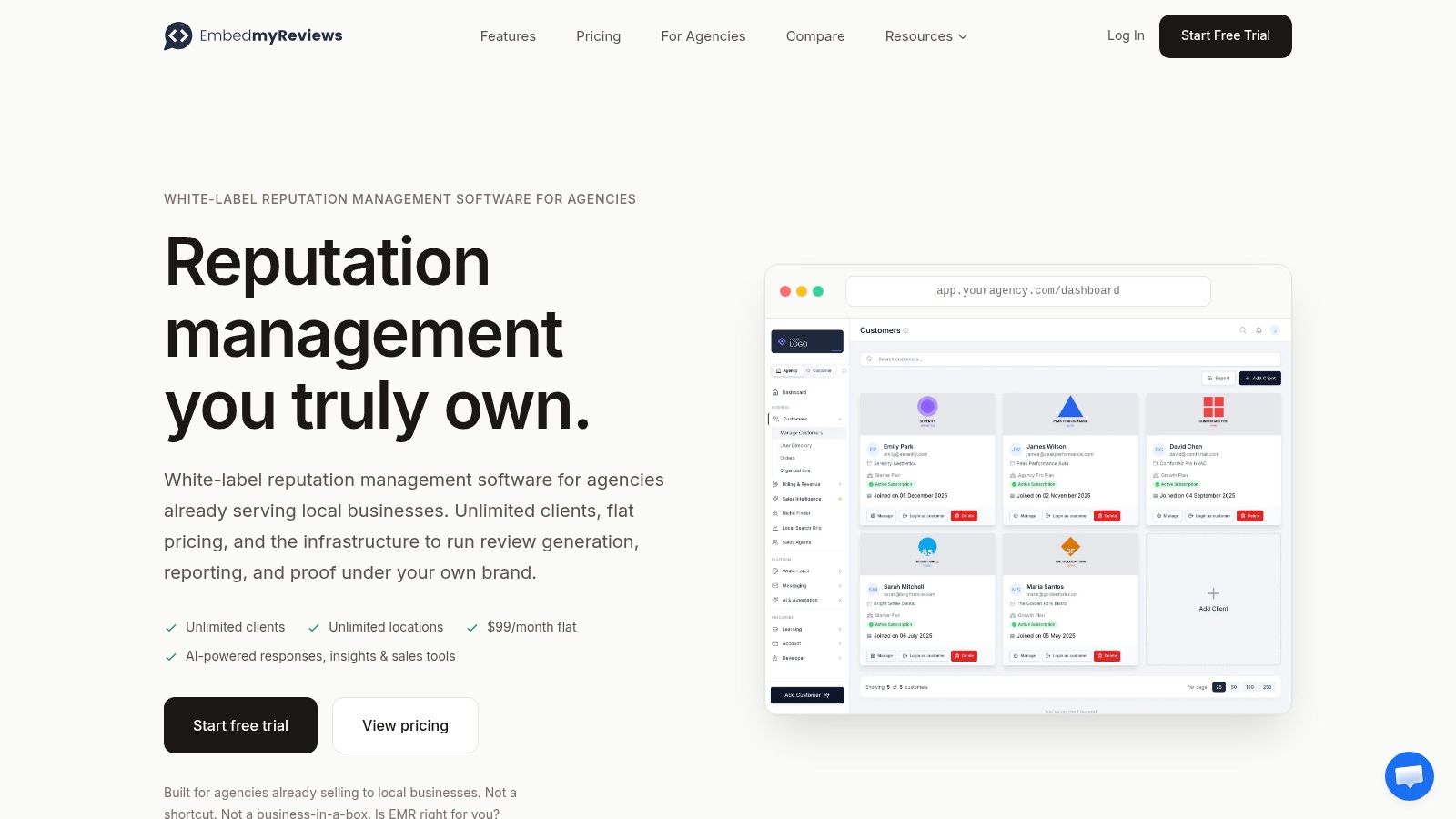
EmbedMyReviews is the strongest fit for agencies that want to make reputation management look and operate like their own service rather than a reseller add-on. The platform brings review collection, responses, Google Business Profile posts, local rank tracking, analytics and sales intelligence into one branded environment.
Its white-label depth goes beyond a logo swap. Agencies can use a custom domain with SSL, branded interfaces, help content, API documentation, page-building tools and client-facing reports. The platform supports 27 interface languages, which matters for agencies serving multilingual portfolios or regional teams. There's also no vendor attribution in the client experience, an important distinction when an agency is charging for a proprietary-looking service.
Where the platform earns its place
EmbedMyReviews monitors reviews across 67 or more sources, supports email, SMS and WhatsApp campaigns through agency-owned provider accounts, and offers multi-step feedback funnels, QR and NFC tracking, private feedback routing and first-party testimonials. Agencies can use their own messaging providers, helping preserve wholesale rates and regional flexibility.
AI responses can run on agency-provided OpenAI or OpenRouter keys, with shared prompts, tone controls and human approval. That arrangement gives agencies more control over data and usage costs than a closed AI allowance. Google Business Profile posting, client email approvals, media handling and location geotags extend the workflow beyond review collection.
The operational layer is equally important. Local Search Grid tracks rankings across geographic areas, while scheduled reports, multi-location dashboards, role-based permissions and white-label PDF exports reduce manual account management. Sales Intelligence adds audit reports, Trust Score analysis, competitor benchmarking and AI visibility testing, giving sales teams something more useful than a generic reputation score.
Practical rule: A white-label platform should protect the agency's margin at the point where client count and location count increase, not only look branded during a demo.
The commercial model is unusual. A flat $99 per month covers unlimited clients, locations and users in the base platform, with no per-location or seat-based pricing there. Agencies can create client plans, apply credit limits, sell add-ons, use Stripe billing and manage sales territories and commissions.
For self-storage operators, the combination of location isolation, review monitoring, Google posts and rank tracking supports branch-level management. SMEs gain a packaged reputation service without assembling several tools. E-commerce brands can connect Shopify or WooCommerce and monitor feedback across relevant sources. Marketing managers get a central dashboard, approval workflows and scheduled evidence for stakeholders.
The trade-off is scope. Teams wanting only a simple Google review request tool may find the broader platform more than they need. Agencies should also test provider setup, AI governance and client permissions before promising a fully automated service.
Pilot test: Connect one self-storage location, one SME and one e-commerce account. Check whether the agency can launch a branded request campaign, approve an AI response, publish a Google post, export a report and remove or transfer access cleanly. The pilot should also confirm that client data, messaging credentials and AI keys remain under the intended ownership model.
2. BrightLocal
BrightLocal suits agencies that already sell local SEO and want review management inside a broader local-search workflow. Its white-label reports, password-protected client portal and branded external report links help clients see the agency's identity rather than a third-party dashboard.
The platform's Reputation Manager centralises review monitoring, alerts and responses. Automated report scheduling and lead-generation widgets support agencies that need to turn local audits into sales conversations. API access and integrations, including Google Analytics, help connect reputation activity with wider campaign reporting.
The agency trade-off
BrightLocal has a strong UK and local SEO pedigree, which makes it a natural option for agencies working with self-storage operators, local SMEs and multi-location brands. A client that needs citation work, rank tracking and review oversight may prefer one established local-search environment instead of separate tools. Agencies handling local listings can also connect the review programme with their citation management service.
The limitation is positioning. Review management can feel secondary when the agency's main workflow revolves around the wider SEO suite. That may be perfectly acceptable for a marketing manager buying an integrated local campaign, but less suitable for an agency trying to sell a dedicated reputation product with a distinctive client portal.
Per-location pricing also needs careful modelling. A small single-site SME may be easy to package, while a self-storage brand with many facilities can create a growing software cost unless the client plan reflects location volume. E-commerce brands with few local branches may not use enough of the local SEO functionality to justify the wider platform.
Pilot test: Use one multi-location client and one single-site client. Send a branded report link to each, review the portal from the client side, and calculate the agency's software cost as locations increase. Confirm that review alerts, response ownership and report exports fit the agency's existing local SEO process.
3. Reviewshake
Reviewshake suits agencies that want to launch a branded review service without building a delivery system from scratch. Its custom domain, agency logo, colours, branded emails and multi-location routing help clients experience the service as part of the agency's offer, rather than as a separate vendor account.
Email and SMS campaigns handle review requests, while a unified inbox keeps reviews and responses together. Location selection and routing matter for franchise-style accounts and self-storage operators, where feedback needs to reach the correct branch or manager. The agency should still check whether the client-facing reports show location performance clearly enough for regular operational reviews.
A focused reseller model
Reviewshake's narrow scope can support a cleaner sales proposition. An agency does not need to configure a broad CRM, listings suite or marketing automation system before testing a reputation service. Documentation and agency plan options make initial packaging relatively clear, which helps a small team test demand without adding a complex fulfilment process.
The trade-off is breadth. Agencies that require deep local SEO, advanced prospecting, extensive integrations or wider automation may need another platform alongside Reviewshake. Entry tiers aimed at single businesses may also become restrictive as a client adds locations, affecting the agency's margin and the price it must charge.
The platform is a plausible fit for SMEs wanting a straightforward review workflow, marketing managers who need a clean inbox and e-commerce brands connecting feedback requests to customer communications. Self-storage operators should test branch routing and reporting before committing, particularly if regional managers need separate access.
Review data ownership needs an explicit discussion before rollout. Confirm export formats, retention after cancellation, responsibility for messaging accounts and access to historical reviews. Also review what happens if review data changes or Google visibility shifts, as explained in this guide to why Google reviews disappear. A branded interface does not mean the agency controls the underlying data.
Pilot test: Brand a test domain, create two locations, send email and SMS invitations, route a response to separate users and export the resulting data. For an e-commerce account, connect the request workflow to the existing customer process. Proceed only if clients see the agency brand at key touchpoints and the agency can retrieve its data without vendor-dependent workarounds.
4. Grade.us
Grade.us is built around the agency model rather than adapted for it. As a Birdeye company, it provides full white-label dashboards and reports on the appropriate agency plan, multi-tier sub-accounts, client permissions and review funnels.
Brand control is one of its clearest advantages. Agencies can customise the dashboard, reports and deeper visual details such as the favicon, creating a more convincing private-label experience than platforms that only replace a logo. That matters when a marketing manager expects the agency to own the service rather than broker access to another vendor.
Useful for selling the service
Grade.us includes email and SMS drip campaigns, review funnels, prospect reports and an ROI calculator. The prospecting tools are useful for agencies that want to demonstrate reputation gaps before a client signs. A sales team can show where a business needs attention, then move the account into the same operational environment after purchase.
The interface can feel utilitarian compared with newer products. That isn't automatically a disadvantage. A plain interface may be preferable for an account team that values predictable workflows over visual polish, but clients expecting a modern consumer-style portal may need more onboarding.
Want a free audit like this for your own site?
We'll show you exactly what's holding your rankings and conversions back. No sales pitch.
Get My Free AuditGrade.us fits SMEs and local operators that need a dedicated reputation service. Self-storage teams can use sub-accounts and permissions to separate facilities or regional managers. E-commerce brands may find the review funnels useful, although a wider commerce integration layer could be needed. Marketing managers should examine whether the platform's reporting maps to customer-service outcomes rather than relying only on ratings and review volume.
A separate SEO suite may create feature overlap. Agencies should avoid paying twice for reporting, review alerts or rank-related workflows unless the specialised white-label experience justifies the additional system.
The platform's strongest use case is an agency that wants to sell review management as a distinct, repeatable product, not merely add reviews to an existing SEO dashboard.
Pilot test: Build a prospect report, create a sub-account, apply agency branding and invite a mock client with restricted permissions. Then compare the effort required to produce a monthly report against the agency's current process. Test a negative review workflow as carefully as a positive one, including escalation and approval.
5. GatherUp
GatherUp combines public review generation with private customer-experience signals. Alongside review requests, monitoring and AI-assisted responses, it supports NPS and surveying workflows. That makes it particularly relevant when an agency needs to explain not only what customers publish publicly, but also what they report privately.
Public reputation and private feedback
The distinction matters for self-storage operators. A public review might mention access, billing or staff communication, while a private survey can reveal dissatisfaction before it becomes a published complaint. For SMEs, the combination can turn reputation management into a customer-service improvement programme. Marketing managers gain a richer reporting conversation than “the average rating moved”.
GatherUp supports email and SMS requests, review funnels, automation, multi-location dashboards and white-label setup with branding and custom-domain elements. Agencies can use the platform to manage a portfolio while preserving a consistent presentation for clients.
The main commercial uncertainty is pricing transparency. Larger agency tiers require a sales conversation, so margin modelling takes longer than it does with a clearly published flat plan. The interface prioritises function over visual novelty, which may suit operational users but could require a more carefully designed client report.
E-commerce brands should test whether the survey and public-review flows fit their post-purchase journey without creating excessive messages. SMEs should check how much configuration is needed before a campaign can run reliably. A marketing manager should ask where private feedback is stored, who can see it and how long it remains available after a contract ends.
Pilot test: Run a small feedback flow that separates private dissatisfaction from public review requests. Review the permissions, alerting and escalation process with a client manager. The pilot should show whether recurring themes can be reported alongside public review metrics without exposing sensitive customer information to the wrong users.
6. Synup
Synup is a broad local-presence platform that combines listings, social publishing and reputation management. Its white-label dashboard, widgets, landing pages and reports can run under the agency's brand, giving clients a single destination for local marketing activity.
Review invitations, monitoring, response workflows and analytics sit alongside client workspaces, per-client billing and API keys. Hosted client logins and branded assets make Synup a strong option for agencies managing franchise, retail or other large multi-location portfolios.
When consolidation beats specialisation
Synup is most attractive when vendor sprawl is the main problem. A self-storage group may need listing consistency, local content, review responses and reporting across several facilities. Combining those workflows can reduce the number of credentials and hand-offs the account team manages.
The platform may be excessive for a client that only needs review requests and response alerts. E-commerce brands without a substantial local footprint may also struggle to use enough of the wider functionality. Quote-based pricing makes the decision more dependent on a sales conversation, particularly for agencies that need to protect margins across many clients.
Data boundaries deserve close attention. Per-client workspaces and API keys can help separate accounts, but the agency should confirm export rights, role permissions, retention and the process for transferring a client to another provider. White-label access shouldn't become a reason for the agency to retain client-owned listings or review data after termination.
Marketing managers should also test the client portal rather than judging the administrator dashboard alone. A platform can be powerful for an agency while still confusing the local manager who must approve a post or respond to a complaint.
Pilot test: Configure one client with listings, social publishing and review workflows, then invite a non-technical manager to complete routine tasks. Measure whether the account team saves time after consolidation. Before expanding, request a written pricing model for the client's location count and a documented data-export process.
7. LocalClarity
LocalClarity is designed for complex review operations across many locations and sources. Its ReviewsInbox centralises monitoring and responses, while bulk workflows, portfolio analytics and audit trails support teams that need consistent governance.
White-label deployment can run on an agency subdomain with custom branding. Historical record retention, including removed reviews, is especially relevant for agencies working with regulated, scrutinised or high-volume accounts. It gives the team an evidence trail when a client asks what changed, when a review disappeared or how a branch handled a complaint.
Built for review governance
LocalClarity is a strong candidate for self-storage operators with multiple facilities, franchise-style businesses and marketing managers who need branch comparisons. Agencies can analyse review-source mix, location performance and response operations without reducing every account to one blended score.
That focus is also the limitation. LocalClarity is narrower than an all-in-one local marketing platform, so agencies may need separate tools for listings, content, CRM or rank tracking. Pricing and white-label tiers are sales-led, which makes it harder to compare total cost without a detailed portfolio brief.
The platform's agency partner programme may suit providers that want influence over the product roadmap. However, a partnership conversation shouldn't replace technical due diligence. Agencies should ask how historical data is exported, how deleted reviews are represented, how permissions work and whether client-owned accounts remain accessible after a contract ends.
For teams that also need location-level search measurement, the workflow may need a companion system such as Google Maps rank tracking. E-commerce brands with limited local operations may find LocalClarity too specialised, while local SMEs may need a simpler tool unless reputation governance is a central service.
Pilot test: Load several locations with different review sources and simulate a complaint escalation. Test bulk response approval, historical records, audit-log visibility and client access. Ask for a full commercial proposal that separates platform fees, white-label costs, onboarding and any usage charges before making a portfolio commitment.
8. Cloutly
Cloutly takes a modern campaign-led approach to review generation. Its partner tier can remove Cloutly branding, use domain proxying and apply agency brand assets, allowing a marketing team to package review collection as its own service.
Email and SMS invitations, review funnels, AI-assisted replies and local marketing insights support a focused workflow. Video and text campaigns may appeal to e-commerce brands and service businesses that want more expressive customer feedback than a standard star-rating request.
Fast launch, narrower ecosystem
Cloutly's agency playbooks and setup guidance make it suitable for a team that wants to launch quickly. SMEs can receive a straightforward review programme, while marketing managers get a modern interface that may be easier to present internally than an older operational dashboard.
The platform's ecosystem is smaller than those of established local marketing suites. Agencies needing extensive listings management, deep rank tracking or broad API coverage may need companion software. That creates a margin question: a low-friction review product can become expensive operationally if account managers must move data between systems.
Self-storage operators should test location routing, manager permissions and complaint escalation rather than focusing only on review velocity. E-commerce brands should confirm that SMS consent, customer data handling and post-purchase timing fit the existing CRM. The agency should also establish whether AI replies require approval and whether prompts or customer information are retained for model use.
Cloutly is best suited to agencies that value a polished reseller launch and a focused review service. It is less suited to teams looking for a single platform to manage every local-search function.
Pilot test: Launch one branded campaign for an SME and one for an e-commerce brand. Check domain setup, invitation delivery, consent records, AI reply approval and report branding. Then calculate the manual work required to connect campaign results to the agency's CRM and monthly client report.
Top 8 White-Label Review Software Comparison
| Product | Implementation complexity | Resource requirements | Expected outcomes | Ideal use cases | Key advantages |
|---|---|---|---|---|---|
| EmbedMyReviews | Medium, custom domain, BYOK and white‑label setup | Low–Medium budget (flat pricing), DNS/AI/messaging config, minimal ongoing per-location fees | Agency-owned, scalable review + local insights stack with consolidated workflows and reporting | Agencies, franchises and consultants wanting full ownership and predictable costs | 100% white‑label on agency domain, flat unlimited pricing, BYOK for AI/messaging, integrated rank tracking & widgets |
| BrightLocal | Low, straightforward onboarding, report templates | Per-location fees can accumulate; SEO analyst time for optimization | Improved local SEO visibility and centralized review monitoring with branded reports | UK-focused agencies and teams combining SEO + reviews for multi-location clients | Strong local SEO pedigree, white‑label reports and client portal, easy client access |
| Reviewshake | Low, fast to brand and deploy on custom domain | Seat/location pricing; modest technical overhead | Quick rollout of a white‑label review product with unified inbox and invite campaigns | Agencies reselling review services and multi-location portfolios needing speed to market | 100% white‑label domain, multi‑location routing, clear agency documentation |
| Grade.us | Medium, multi‑tenant and deep branding require setup | Agency plan costs; admin for sub‑accounts and prospecting tools | Packaged review services with prospecting/ROI tools and deep branding control | Agencies focused on sales enablement and packaged review offerings | Mature agency workflows, deep branding (favicon, reports), multi‑tier sub‑accounts |
| GatherUp | Medium, includes NPS and feedback workflows | Pricing often sales‑led for larger tiers; setup for NPS flows | Combined CX signals + public review generation for richer reporting and insights | Brands/agencies wanting NPS + review operations and multi‑location management | NPS and survey integration with review funnels, AI response assistance |
| Synup | High, full local stack and white‑labeling across features | Higher, often quote‑based; integration across listings and publishing | Single platform for local presence and reputation, reducing vendor sprawl | Large franchises/retail and agencies needing full‑stack local presence | Full‑stack local presence + reviews, deep white‑label depth, scalable for large portfolios |
| LocalClarity | Medium–High, built for enterprise multi‑location workflows | Sales‑led pricing; requires admin resources for audit trails | Scaled review operations with historical retention and portfolio analytics | Complex, regulated multi‑location brands and agencies | Central ReviewsInbox, historical record retention, portfolio analytics |
| Cloutly | Low, rapid reseller setup and domain proxying | Generally lower cost; may need pairing with SEO tools | Faster review velocity via modern campaigns and easy reseller rollout | Agencies seeking quick productization for SMB clients | Fast branding/launch, modern UX, video/text campaign support and AI replies |
Shortlist, Audit and Pilot Before You Commit
The right platform depends less on the longest feature list than on the service the agency intends to sell. EmbedMyReviews is the strongest candidate for agencies seeking broad ownership, flat base pricing and a combined reputation, local-search and sales workflow. BrightLocal and Synup suit agencies that already deliver wider local marketing. Reviewshake, Grade.us and Cloutly are more focused reseller options, while GatherUp and LocalClarity stand out when customer experience, governance or multi-location review operations matter most.
The shortlist should be narrowed to two or three platforms before any commercial commitment. Each finalist should answer the same operational questions:
- Brand control: Can clients access the system through the agency's domain, with vendor branding removed from dashboards, emails, reports and support materials?
- Data ownership: Can the agency export reviews, campaign history, customer records, response logs and audit trails in a usable format?
- Client separation: Do permissions isolate locations, teams and accounts without exposing one client's information to another?
- Compliance controls: Does the workflow preserve consent, label incentives, retain an audit trail and prevent selective suppression of negative feedback?
- Commercial fit: Does pricing protect the agency's margin as clients, users, locations and message volume increase?
- Integration depth: Can the platform connect to the agency's CRM, ecommerce system, messaging providers, reporting stack and internal API workflows?
- Operational evidence: Can reports show response time, unresolved complaints, recurring themes, location differences and source-level trends rather than only review volume and average rating?
Compliance deserves particular attention in the UK. Since 6 April 2025, fake reviews, concealed incentivised reviews and misleading presentation of review information have been banned practices under the Digital Markets, Competition and Consumers Act. The rules can affect organisations that publish, commission or facilitate review activity, not only the business requesting reviews (UK government guidance on fake reviews). A white-label model can increase perceived responsibility because clients may assume the agency owns the complete process.
The platform should also support honest interpretation. UK guidance stresses that published review information must provide a full and accurate picture of customer experiences, including safeguards against fake reviews and misleading ratings (CMA guidance for online review sites). A dashboard that increases review volume while hiding branch-level problems can create a more serious risk than a modest rating.
Amax Marketing can help identify which audience segment and locations should enter the test first through its complimentary marketing audit. The practical next step is to choose one client or one location, document its current workflow, configure two shortlisted platforms and run real requests, approvals, responses, reporting and data exports. Keep the winner only if clients see the agency's brand, account teams save meaningful effort, and the commercial model still works when the pilot becomes a portfolio.


